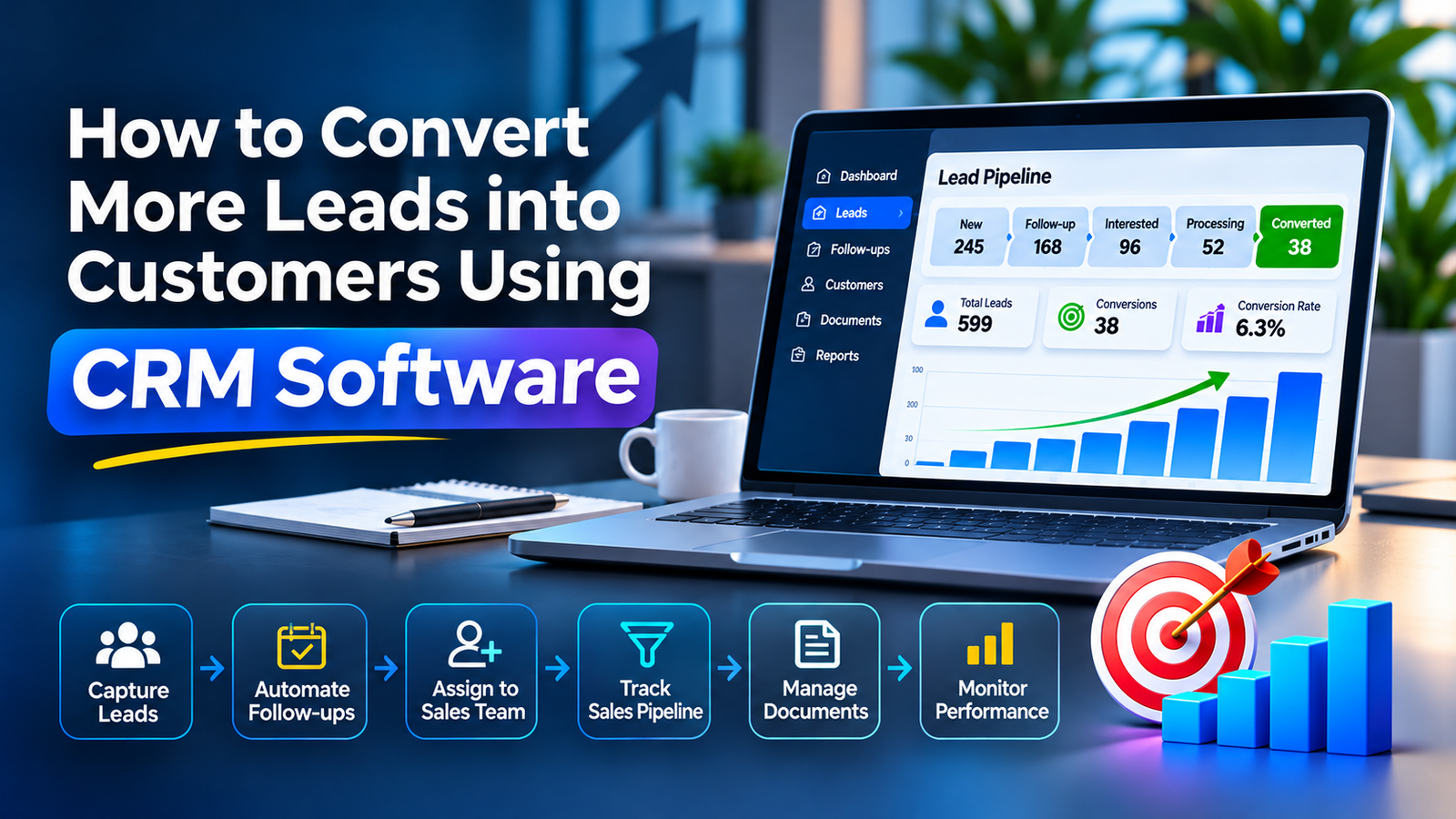
How to Convert More Leads into Customers Using CRM Software
22
Oct
How to Convert More Leads into Customers Using CRM Software
While generating leads constitutes a vital imperative for any enterprise, it is the successful conversion of these prospects into paying clientele that truly catalyzes organizational growth.
Numerous enterprises allocate substantial sums, often amounting to thousands of rupees, toward Google Ads, Facebook advertising, social media campaigns, and various lead-generation initiatives.
Yet, despite the steady influx of inquiries, these organizations find themselves unable to effectively translate prospective clients into concrete sales.
What precipitates this occurrence?
Prevalently, the core issue is not the generation of leads but rather the deficiencies in their management, characterized by procrastinated follow-ups, forfeited opportunities, and an absence of effective communication.
In this context, CRM software emerges as an indispensable instrument for contemporary enterprises.
A Customer Relationship Management system empowers organizations to systematically catalog customer data, monitor prospective leads, automate follow-up communications, and oversee the complete sales lifecycle through a unified platform.
Let's understand how CRM software can help your business convert more leads into customers.
1. Consolidate all lead acquisition within a single, unified platform.
A primary challenge confronting enterprises lies in the effective management of leads originating from a diverse array of channels.
For instance, a lending institution may encounter inquiries via:
- Google Ads campaigns
- Facebook and Instagram Lead Forms
- Website inquiry forms
- WhatsApp inquiries
- Direct phone calls
- Referral partners
The independent administration of these leads via disparate tools such as spreadsheets, WhatsApp messages, or physical notebooks creates a significant risk, allowing crucial inquiries to be overlooked with alarming ease.
A Customer Relationship Management system consolidates all customer inquiries onto a single, centralized platform.
Through the implementation of automated lead capture and robust management systems, enterprises can effectively structure incoming inquiries, preserve comprehensive customer records, and guarantee that their sales personnel have immediate access to pertinent lead data.
By eliminating fragmented lead data and superfluous manual labor, your organization can redirect its team's efforts toward engaging prospective clients rather than juggling disparate platforms.
2. Follow Up With Leads at the Right Time
Be aware that a prospective client may opt for a rival firm solely on the basis of their superior response velocity.
In sales, timing matters.
Should a sales representative reach out to a prospective borrower regarding a personal loan application only after a two-day delay, the client is likely to have already engaged with a competing lending institution.
Neglecting to conduct timely follow-ups may precipitate the forfeiture of prospective commercial ventures.
CRM software helps solve this problem through:
- Follow-up reminders
- Lead activity tracking
- Last contact date monitoring
- Next follow-up scheduling
- Real-time lead status updates
Sales agents can identify which customers need attention and prioritize their daily calling activities.
Consistent follow-up mechanisms are instrumental in sustaining customer engagement and mitigating the risk of alienating prospective clients who remain interested in the offering.
3. Allocate leads to the appropriate sales representatives.
The manual oversight of leads presents escalating challenges as your enterprise expands.
When several agents simultaneously address identical customer inquiries, the resulting ambiguity often leads to redundant contacts and a deteriorated customer experience.
A Customer Relationship Management system empowers administrators and supervisors to allocate or reassign leads to the most suitable agents.
Role-based dashboards empower each team member to access exclusively the data pertinent to their specific responsibilities.
For example:
- Administrators are empowered to oversee the comprehensive performance of the enterprise.
- Sales agents possess the capability to administer their designated leads and oversee all subsequent follow-up actions.
- Backend agents are capable of managing document verification and processing tasks.
- Supervisors possess the capacity to oversee team activities and evaluate performance metrics.
Enhanced operational synergy, precisely delineated accountability, and a marked elevation in collective team output constitute the primary business advantages.
Fourthly, meticulously monitor each prospect as they advance through the sales pipeline.
All prospective leads are not necessarily primed for immediate acquisition.
While certain clients have expressed interest yet require further details, others are currently in the process of evaluating competing proposals, coordinating documentation, or awaiting final authorization.
In the absence of adequate tracking mechanisms, it proves exceedingly challenging to ascertain the current status of every client.
Customer relationship management (CRM) software empowers organizations to track prospective clients as they navigate various phases of the sales pipeline, including:
- New Leads
- Follow-up Leads
- Interested Leads
- Logged-in Applications
- Processing Leads
- Approved Leads
- Disbursed Leads
- Not Interested Leads
This affords business proprietors a lucid comprehension of their sales pipeline.
For loan agencies and DSAs, tracking the journey from initial inquiry to loan disbursement is especially important.
By proactively identifying latent opportunities, diagnosing conversion impediments, and implementing corrective measures prior to the attrition of prospective clients, organizations can secure a tangible strategic advantage.
5. Leverage Reports and Analytics to Enhance Sales Performance.
Directing a sales organization in the absence of performance metrics is tantamount to operating a commercial enterprise while remaining entirely oblivious to its revenue streams.
It is imperative to identify precisely which initiatives are yielding tangible outcomes.
Customer relationship management reporting and analytics enable business proprietors to assess:
- Total leads received
- Leads assigned to agents
- Leads currently in progress
- Successful conversions
- Pending follow-ups
- Agent-wise performance
- Overall lead conversion rates
Such insights empower managers to pinpoint high-performing agents, diagnose areas of vulnerability, and formulate more strategic business decisions.
Consequently, should a particular agent demonstrate a sustained superiority in lead conversion relative to their peers, the management team may analyze their methodology and leverage these insights to elevate the collective efficacy of the entire workforce.
Business Advantage: Cultivate decision-making grounded in empirical data, thereby eliminating reliance on speculative assumptions.
6.Keep Customer Documents Organized
Within the financial services sector, the procurement and administration of client documentation constitute a fundamental component of the sales lifecycle.
Loan applications often require documents such as:
- PAN Card
- Aadhaar Card
- Bank Statements
- Salary Slips
- Business Documents
- Other KYC Documents
The fragmentation of document management across disparate WhatsApp threads, email inboxes, and folder hierarchies inevitably engenders superfluous delays.
A customer relationship management system equipped with document management functionalities enables teams to upload, organize, and verify client documentation directly within the platform.
Backend teams are equally capable of streamlining the management of document verification and processing operations.
The organization stands to gain a significantly streamlined workflow, enhanced accessibility to critical documentation, and a more seamless loan application procedure.
7. Monitor Your Team's Activities and Accountability
In scenarios where numerous agents manage customer inquiries, it becomes imperative for business owners to maintain comprehensive visibility into their respective activities.
In the absence of adequate monitoring mechanisms, discerning overlooked follow-ups, dormant leads, or latencies in customer engagement becomes increasingly arduous.
Capabilities including activity logs, audit trails, and role-based access controls are instrumental in enabling enterprises to uphold transparency.
Executives are empowered to oversee critical initiatives, monitor the progression of leads, and evaluate the efficacy of individual team members in managing their allocated opportunities.
The enterprise derives substantial advantages through enhanced accountability, streamlined workflow governance, and significantly elevated operational transparency.
Why Choose Techwhizzc CRM for Lead Management?
Effective lead management extends far beyond the mere archival of customer contact information; it necessitates a comprehensive ecosystem designed to underpin and optimize sales operations.
Techwhizzc CRM is designed to help DSAs, loan agents,