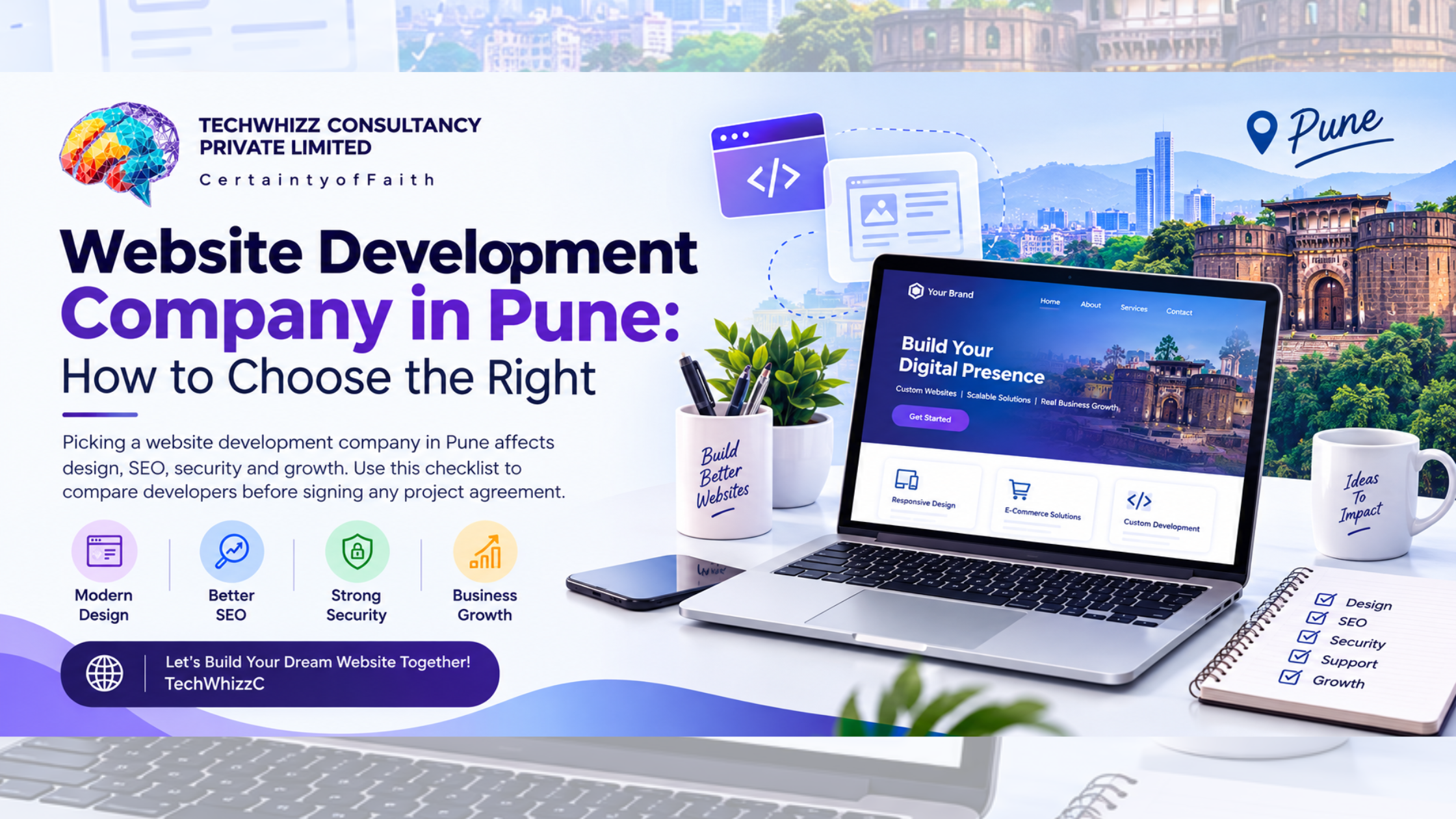
How To Choose Website Development Company in Pune
15
Sep
How To Choose Website Development Company in Pune
How to Choose the Right Website Development Company
A business website usually ends up doing more work than any single employee. It introduces your brand to people who've never heard of you, answers questions before a prospect ever calls, takes orders while you sleep, and backs up everything your marketing team promises. Get the early decisions wrong - the platform, the structure, the way it's built - and you end up paying twice: once to launch it, and again to fix it two years later.
That's really why picking a website design company in Pune deserves more thought than comparing three quotes and going with the middle one. Here's what's actually worth checking before you commit.
Start With Deciding Goal Of Website
Before anyone touches a design tool, get clear on the outcome you want. Are you trying to get people to call you, fill out a form, buy something directly, book a slot, or simply understand what you do well enough to reach out? A lead-generation site and an online store are built differently from the ground up, so this decision shapes everything that follows- not the other way around.
Match the Company to the Type of Site You Need
"Business website" covers a lot of ground. A corporate site built around services and case studies is a different job from an ecommerce store handling products and checkout, which is different again from a custom web application running a booking system or a client dashboard. If you're building an online store, look specifically for a team with real e-commerce website development work behind them- not just a mention of it in their services list.
Look at Finished Work, Not Just the Pitch
Every agency's homepage claims strong design and clean code. The portfolio tells you what's actually true. Open a few live sites they've built and check how the navigation feels, how fast pages load, whether forms actually submit, and whether the mobile version was clearly an afterthought or genuinely planned. If your industry has any quirks, look for a project in a similar space- it saves you from being their first attempt at something.
Treat Design and Development as Two Separate Skills
Design decides how a visitor understands and moves through your site. Development decides whether any of it actually works. A website design company in Pune worth hiring should be able to walk you through their process-audience research, wireframes, a plan for conversions, and usability checks-rather than jumping straight to color palettes. A site that looks polished but confuses visitors isn't doing its job, no matter how nice the mockups looked.
Push Past "It's Responsive" on Mobile
Almost every developer will tell you their sites are mobile-friendly. The better question is how they test that claim. Menus, forms, buttons, product listings and checkout flows all behave differently on a small screen than a desktop layout scaled down- ask specifically how they handle each of these before launch, not just whether the layout "resizes."
Understand the Technology, Even If You Don't Build It Yourself
You don't need to write code to make a smart decision here, but you should understand why a particular CMS, framework or platform was chosen for your project-and whether it can grow with you. A service site today might need customer logins, online payments, CRM integration or marketing automation in two years. Ask directly whether the proposed setup can handle that, or whether you'd be rebuilding from scratch.
Get SEO Into the Conversation Early
Technical SEO is far cheaper to build in than to retrofit. URL structure, heading hierarchy, canonical tags, an XML sitemap, image optimization, page speed and structured data all belong in the original build plan, ideally with an SEO person involved alongside the developers rather than brought in after launch to patch things up.
Plan for Who Updates the Content Later
Websites aren't static once they go live. You'll likely need new service pages, blog posts, updated pricing or fresh product listings down the line. Know if a cms is included, if your own team can do basic edits without having to call the agency every time, and whether content support is included in the maintenance package or billed separately
Know When Custom Development Actually Pays Off
A basic setup is sufficient for most operational requirements . Custom website development earns its higher cost when you have a genuinely specific process to support — a quotation tool, a booking workflow, inventory syncing, or an API connection to a system you already use. It should solve a real problem, not just sound more impressive in a proposal.
Compare Quotes Based On Scope, Not Just Price
Searching for website development cost in Pune turns up a wide price range, and that's expected — no two projects are the same. Rather than asking "how much," ask "what exactly is included." Two proposals at different price points might cover completely different amounts of work once you look closely at testing, SEO setup, content migration, training and post-launch support.
Ask About Security Before It Becomes a Problem
If your site will ever handle customer details, payments or login credentials, security can't be an afterthought. Ask how the team handles HTTPS, admin access controls, authentication, regular updates, backups and database protection — and get specifics, not just a reassurance that "we take security seriously."
Get Ownership in Writing From Day One
This is one of the most common sources of trouble later. Confirm, in writing, who owns the domain, hosting account, source code, database, CMS login, analytics and Search Console access. If you ever need to switch vendors or bring development in-house, you want that access to already be yours.
Check How They Interact , Rather Just How They Code
Plenty of technically solid projects go sideways because nobody knew who to ask for a status update. Find out how the team handles requirements, approvals, feedback rounds and change requests, and who's actually responsible for keeping you updated as the project moves along.
Confirm Testing and Support Aren't an Afterthought
Ask whether there's a formal testing phase covering browsers, devices, forms, links, payments and performance before launch and what happens after. Websites need attention beyond day one: security patches, browser changes, new integrations, and content that keeps growing. Know upfront what's included in support and what gets billed as extra.
Local Isn't Everything, But It Can Help
Working with a web development company in Pune makes face-to-face conversations easier if that matters to you, but proximity shouldn't be the deciding factor. Weigh it alongside technical ability, portfolio quality, communication, pricing and how well they can support you after launch-location is one input, not the whole decision.
Consider If You Require More Than Just a Website
Sometimes the website is only one piece of a bigger picture. If you can already see a future need to connect it with a CRM, WhatsApp, payment gateways, marketing tools or accounting software, it's worth choosing a partner who works across software and automation too, rather than one who only builds standalone sites.
A Quick Checklist Before You Sign Anything
Does the company have relevant, verifiable project experience?
Have you actually tested their live portfolio sites?
Is the proposed technology right for your needs, not just familiar to them?
Is mobile responsiveness genuinely built in, not bolted on?
Has technical SEO been part of the plan from the start?
Is security addressed with specifics, not general reassurance?
Is ownership of domain, code and accounts clearly documented?
Is the timeline realistic given the scope?
Is testing a defined phase, not an assumption?
Is post-launch support spelled out?
Does the proposal clearly state what's included and what isn't?
If you can't answer most of these confidently, it's worth getting clarity before signing anything.
Where TechWhizzC Fits In
TechWhizzC Consultancy Pvt. Ltd. builds websites alongside broader technology work-custom software, mobile apps, digital marketing, SEO, IT consulting and business automation-for startups, SMEs and enterprises. That combination matters when your website needs to work with the rest of your systems rather than sit apart from them. If you're planning a new site, a redesign, or something more custom, the TechWhizzC team can help map out the right approach for your specific goals.
Frequently Asked Questions
Who builds business websites in Pune?
Web development companies, software firms, digital agencies and freelance developers all build business websites in Pune. Which option fits best depends on the project's complexity, the technology involved, the budget, the timeline and how much support you'll need after launch.
How much website development cost in Pune?
There's no fixed rate. Cost depends on the number of pages, design complexity, the technology stack, custom features, ecommerce functionality, integrations, content work and ongoing maintenance, so two quotes for the same brief can differ significantly based on scope.
How Can I choose the web development company Correctly?
Decide with your business goal, not just technology. Then compare portfolios, technical ability, development process, communication style, SEO knowledge, security practices, pricing transparency and what's covered after launch.
What is the difference between website design and website development?
Design covers the visual layout, user experience and how information is presented. Development is the technical build that makes the design actually function-forms, databases, integrations and the code behind the pages.
Does every business need a custom website?
No. A standard website works well for straightforward business needs. Custom development makes sense when you need specialized functionality, integrations, automation or a workflow that off-the-shelf tools can't handle.
Why does responsive design matter for a business website?
Responsive design lets a website adapt to different screen sizes, so visitors get a usable experience whether they're on a phone, tablet or desktop-and mobile traffic makes up the majority of visits for most businesses.
Should SEO be planned before development starts?
Yes. URL structure, crawlability, heading hierarchy, page speed, internal linking and canonical tags are far easier to get right during development than to fix on a live site afterward.
Conclusion
The cheapest quote is rarely the best decision. Get clear on what the website needs to achieve, look hard at real finished work, ask direct questions about ownership, security and support, and make sure the scope is written down before anyone starts building. A website built around your actual business needs, not just a template, tends to keep paying off long after launch.
.png)
.png)



.png)


1.png)
2.png)
2.png)
.png)